
RESEARCH
Made-in-Canada CAR T Platform
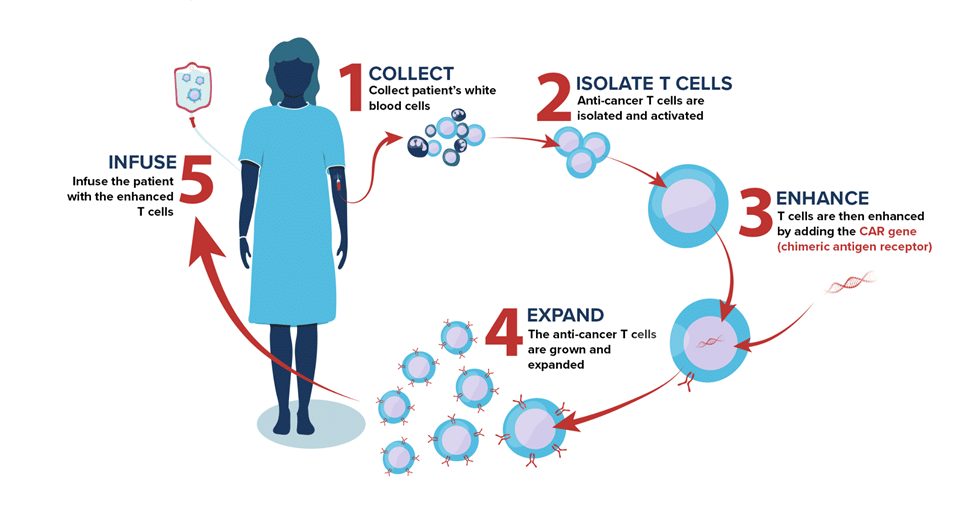
What is CAR T Therapy?
How it Works
Impact
Barriers to Access
- Traditionally requires substantial infrastructure and expertise.
- Limited number of CAR T clinical trials in Canada compared to the USA.
- Variability in access across provinces due to differences in health systems and reimbursement decisions.
Cancer Program
Building Canadian-Led Immunotherapies in Cancer
- Develop biomanufacturing infrastructure and expertise in Canada.
- Expand access to CAR T cell therapy through Canadian-led clinical trials.
- Move Canadian innovations in engineered T cell therapy beyond the laboratory.
Early Collaboration
- Clinical-Grade Plasmids: Developed in the GLP lab of Dr. Robert Holt at BC Cancer’s Genome Sciences Centre, Vancouver.
- GMP Lentiviral vector: Manufactured at the Biotherapeutics Manufacturing Centre at the Ottawa Hospital Research Institute
- Cell product: Final GMP product manufactured at Dr. Brad Nelson’s facility, The Conconi Family Immunotherapy Lab at BC Cancer, Victoria.
CLIC-1901
The First Clinical Trial
Launched in 2019, led by:
• Principal Investigator Dr. Natasha Kekre (The Ottawa Hospital)
• Co-investigator Dr. Kevin Hay (BC Cancer in partnership with the Vancouver General Hospital)
About the trial:
• The trial, “CLIC-01” is designed for patients aged 18–75 with acute lymphoblastic leukemia and non-Hodgkin’s lymphoma that has relapsed or is not responding to standard therapies.
• In June 2022, the team published results from their first 30 patients,
• The trial has now treated approximately 100 patients, with some of the earliest participants now reaching 4 to 5 years post-treatment with no signs of disease – a remarkable outcome in very sick patients who were out of options.
“Today I turned 41, a milestone many thought I would never reach. My daughter now 17 just entered her last year of high school and I am here to see her off. 11 days from now will be 4 years post CAR T cell therapy and still no evidence of disease.”

Camille Leahy
CLIC-01 Clinical Trial participant
“At my check-up 30 days after getting my T-cells back, I was almost clear of cancer. The scan showed that there was almost nothing left. I was gobsmacked.”

Owen Snider
CLIC-01 Clinical Trial participant
The CLIC Platform
Supporting Expansion to Treat a Greater Number of Patients using CAR T Cell Therapies
CLIC is currently expanding its CAR T manufacturing and clinical trial know-how to other sites in Canada in order to enable access to novel CAR T cell therapies to an increased number of patients and in more provinces while also laying down the foundation to facilitate the treatment of other cancers. Today, additional BioCanRx-supported products in the CLIC pipeline include:
- CLIC-2201: a CD22-targeting CAR T undergoing clinical testing in the Phase 1 CLIC-02 trial for adult and pediatric patients with relapsed/refractory blood cancers
- MesoCAR: a mesothelin-targeting CAR T for solid tumors, at the clinical trial-enabling stage
Investments
- Nearly $3.4M in domestic point-of-care-compatible CAR T cell and viral vector manufacturing.
Reach
- Platform supports delivery of therapies in BC, Ontario, Manitoba, and Alberta.
Made-in-Canada
- From plasmids to viral vectors to closed-system CAR T manufacturing.
Made-in-Canada CAR T
The CLIC Network
- Plasmid manufacturing: BC Cancer Genome Sciences Centre (Vancouver)
- Lentivirus manufacturing: Ottawa Hospital Research Institute Biotherapeutics Manufacturing Centre
- CAR T cell manufacturing: BC Cancer Conconi Family Immunotherapy Lab (Victoria); Ottawa Hospital Research Institute Biotherapeutics Manufacturing Centre
- Clinical trial sites – adult: Vancouver General Hospital; Arthur J.E. Child Comprehensive Cancer Centre (Calgary); CancerCare Manitoba (Winnipeg); The Ottawa Hospital; Princess Margaret Cancer Centre (Toronto)
- Clinical trial sites – pediatric: BC Children’s Hospital (Vancouver); Alberta Children’s Hospital (Calgary); The Hospital for Sick Children (Toronto)

Lentivirus manufacturing: Ottawa Hospital Research Institute Biotherapeutics Manufacturing Centre
Clinical trial sites – adult: The Ottawa Hospital
Clinical trial sites – adult: Princess Margaret Cancer Centre (Toronto)
Clinical trial sites – adult: CancerCare Manitoba (Winnipeg)
Clinical trial sites – adult: Arthur J.E. Child Comprehensive Cancer Centre (Calgary)
Clinical trial sites – adult: Vancouver General Hospital
Clinical trial sites – pediatric: The Hospital for Sick Children (Toronto)
Clinical trial sites – pediatric: BC Children’s Hospital (Vancouver)
Plasmid manufacturing: BC Cancer Genome Sciences Centre (Vancouver)
Clinical trial sites – pediatric: Alberta Children’s Hospital (Calgary)
CAR T cell manufacturing: Ottawa Hospital Research Institute Biotherapeutics Manufacturing Centre
CAR T cell manufacturing: BC Cancer Conconi Family Immunotherapy Lab (Victoria)
CLIC Platform Expansion
Research Investments
BioCanRx has invested >$10M, with an additional >$18M contributed by partners, to support research projects that continue to expand the CLIC platform through development and clinical trials of new cellular immunotherapies, increased biomanufacturing and quality control testing capacity, health system adoption and health economic assessments, and patient engagement.
Learn more about these projects and others contributing to the CLIC platform here
Targeted Investments in Next-Generation Manufacturing
Supporting the CLIC Platform
BioCanRx supports CLIC patient engagement, clinical trial protocol development, and health technology assessment-related research through its CSEI program. In a BioCanRx-funded CSEI project, Dr. Kednapa Thavorn, OHRI, is studying how a domestic CAR T cell manufacturing approach could impact Canada’s publicly funded healthcare system and benefit patients. By assessing the cost efficacy of locally produced CAR T cells under the CLIC manufacturing model, Dr. Thavorn’s research supports ongoing efforts to produce personalized immunotherapies more efficiently and affordably, improving access for patients across the country.