Immunotherapy 101
Immunotherapy is a branch of medicine that helps our immune systems to fight disease. The immune system is our body’s network that fights disease and prevents infection. Scientists can create less invasive and more effective treatments for diseases, including cancer, by using the natural ways the immune system works.
There are several different types of cancer immunotherapy (or cancer biotherapeutics) already in use, and the field is growing every day. The main types of cancer immunotherapy in use or development today are:
1. Checkpoint Inhibitors
Release the immune system’s “brakes,” which cancer cells often “press” to shut down T cells, allowing those T cells to attack the cancer.
2. Antibody Therapies
3. Adoptive Cell Therapy
4. Cytokine Therapies
5. Oncolytic (cancer killing) Viruses
6. Cancer Vaccines (currently in development)
What are cancer biotherapeutics?
The term cancer biotherapeutics refers to biologically derived materials that are chosen, processed, or engineered to treat cancer.
A key focus for BioCanRx is immunotherapy products, which include:
• Cancer-killing viruses
• Immune cell therapies
• Antibody therapies
These therapies work by engaging the immune system. They are highly potent, very targeted, and represent an exciting area of research.
Unlike conventional treatments, immunotherapeutics are designed to activate the body’s own defences against cancer. Some can specifically target cancer cells without harming healthy ones. This makes them more effective and often results in fewer, less severe side effects.
Even in early clinical trials, several types of immune therapies have already delivered remarkable results including complete remission for patients who had run out of other options.
How do immunotherapies work?
Over the course of our lives, our cells multiply billions of times and sometimes errors (or mutations) occur. Most of the time, our body recognizes the problem and a mutant cell simply dies or is killed off by our immune system before anything harmful happens.
However, with cancers, these mutant cells replicate themselves and ultimately evolve to avoid detection by the immune system.
Researchers in Canada and around the world have made tremendous advances in discovering how cancer evades our immune system and how to knock down some of these barriers and exploit weaknesses in cancer cells
We are now in a rapidly progressing era of making significant clinical gains harnessing the immune system to attack cancer. Within Canada, researchers have world class expertise in three different therapeutic approaches using the immune system to fight cancer.
What is oncolytic virus therapy?
Oncolytic viruses exploit the fact that many types of cancer do not have the defences that healthy cells possess to fight off viral infection. As a result, tumour targeted viruses can find cancer cells in the body, infect them, replicate inside them and the tumour cell dies in the process. The virus however does not harm healthy cells. Viral infection of common cancer cells also alerts the immune system to the presence of the tumour, leading to the activation of the immune system to attack the cancer. This immune response has two benefits, one to attack the current cancer, and secondly the potential to prevent recurrence or spread to other locations.
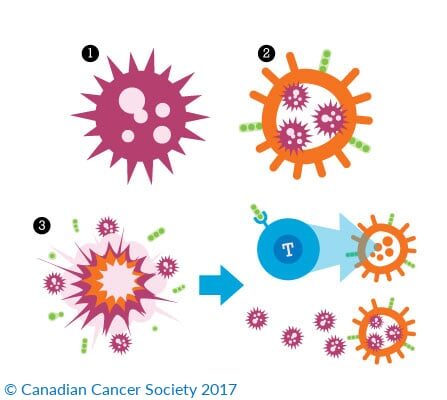
Oncolytic Virus Therapy:
- Oncolytic viruses are a special type of virus that can only infect cancer cells, leaving normal cells healthy
- The virus replicates inside the cancer cell.
- The cancer cell then bursts, releasing markers (antigens) into the body that alert the immune system (T cells) to look for and kill cancer cells, as well as visual particles that can infect other cancer cells.*
*Oncolytic viruses can also be programmed to carry tumour antigens (or markers) and deliver them to the immune system like a vaccine.
What is adoptive cell therapy?
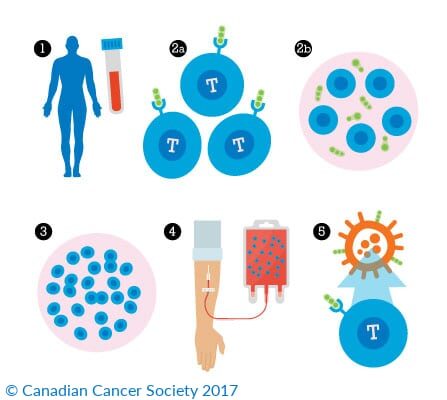
- Blood sample is taken from patient.
- Immune cells (T cells) that recognize cancer cells are isolated.
- T cells can also be taught to recognize cancer cells in the lab.
- The T cells are grown into a large population.
- The T cells or modified T cells are introduced back to the patient.
- These T cells will recognize and kill cancer cells.*
*Immune cells can also be isolated from a patient’s tumour.
.
What is antibody therapy?
Antibodies are proteins made by the immune system and in the context of cancer therapy are used to do one of two things; antibodies can either target or recognize tumour cells, and can be used to specifically deliver toxins or alert the immune system to the presence of the tumour. Alternatively, antibodies are used to manipulate the immune response to tumours to heighten the ability of the immune response to combat the cancer.
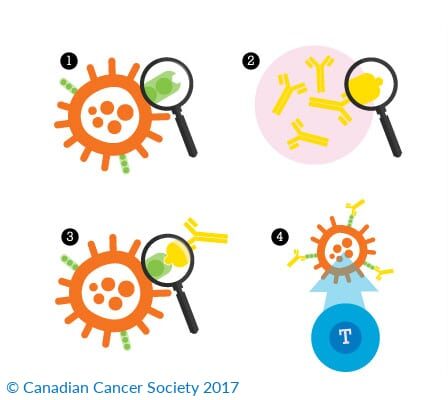
- Cancer cells (like bacteria and viruses) have markers on their surface called antigens that identify them as abnormal cells.
- Scientists can make antibodies in the lab to recognize the antigens on cancer cells, which then bind to them like puzzle pieces.
- By attaching to the antigen, the antibodies mark the cancer cells for destruction by the immune system.
- Immune cells (T cells) recognize the antibodies and destroy the cancer cells.
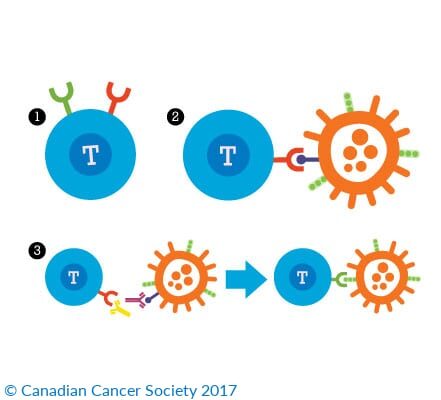
- Immune cells (T cells), have receptors on their surface that allow them to be turned on (or Go) or turned off (or Stop). These stop signals are like brakes that keep the immune system in check and are called checkpoints.
- Many cancers hijack these brakes by making a molecule that triggers them, preventing the immune system from destroying cancer cells.
- Checkpoint inhibitor drugs release the brakes so the immune system can turn on T cells to kill the cancer cells.
What is the real potential of biotherapeutics for cancer treatment?
Researchers recognize that in order to use immune-based therapies effectively, strategies need to be developed to address these three main challenges:
- Directing the immune system to recognize the tumour
- Producing a highly potent immune reaction to the tumour
- Overcoming immune suppression within the tumour
Each of the three platforms within BioCanRx address one or possibly two of these challenges but none overcome all three simultaneously and this is why we emphasize developing therapeutic approaches using combination therapy.
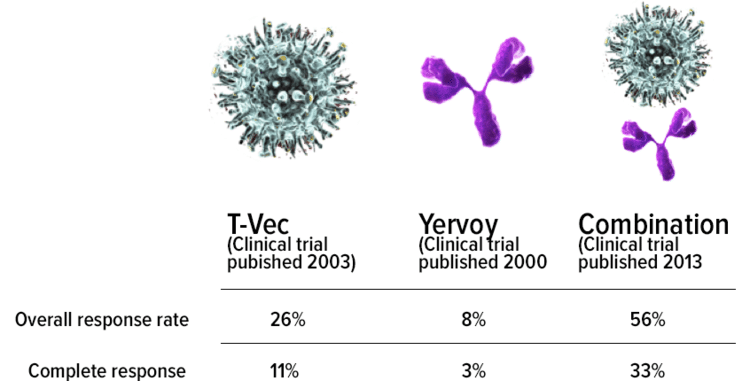
For example, the combination of T-Vec (an oncolytic virus derived from the herpes virus) with Yervoy (an immune checkpoint inhibitor with the biologic ipilimumab) has shown exciting and, arguably, predictable responses in advanced melanoma patients. The table below shows how the combination of the two biotherapies in a 2013 clinical trial resulted in one-third of the study’s participants having a complete response, meaning they were cancer-free.